
Walk through any Tucson neighborhood right now and you’ll see it: door hangers, yard signs, and trucks promising “8-GIG Internet,” “Multi-Gig Speeds,” and “the fastest internet ever.” It’s an arms race of bigger numbers. But almost nobody explaining these numbers to you is explaining what they actually mean — or whether you need anywhere close to that much.
As a provider that builds and operates both fiber optic and fixed wireless networks across Arizona, we get asked constantly: what’s actually the difference, and is fiber always better? Here’s the honest, technical answer — no sales spin.
How Fiber Optic Internet Actually Works
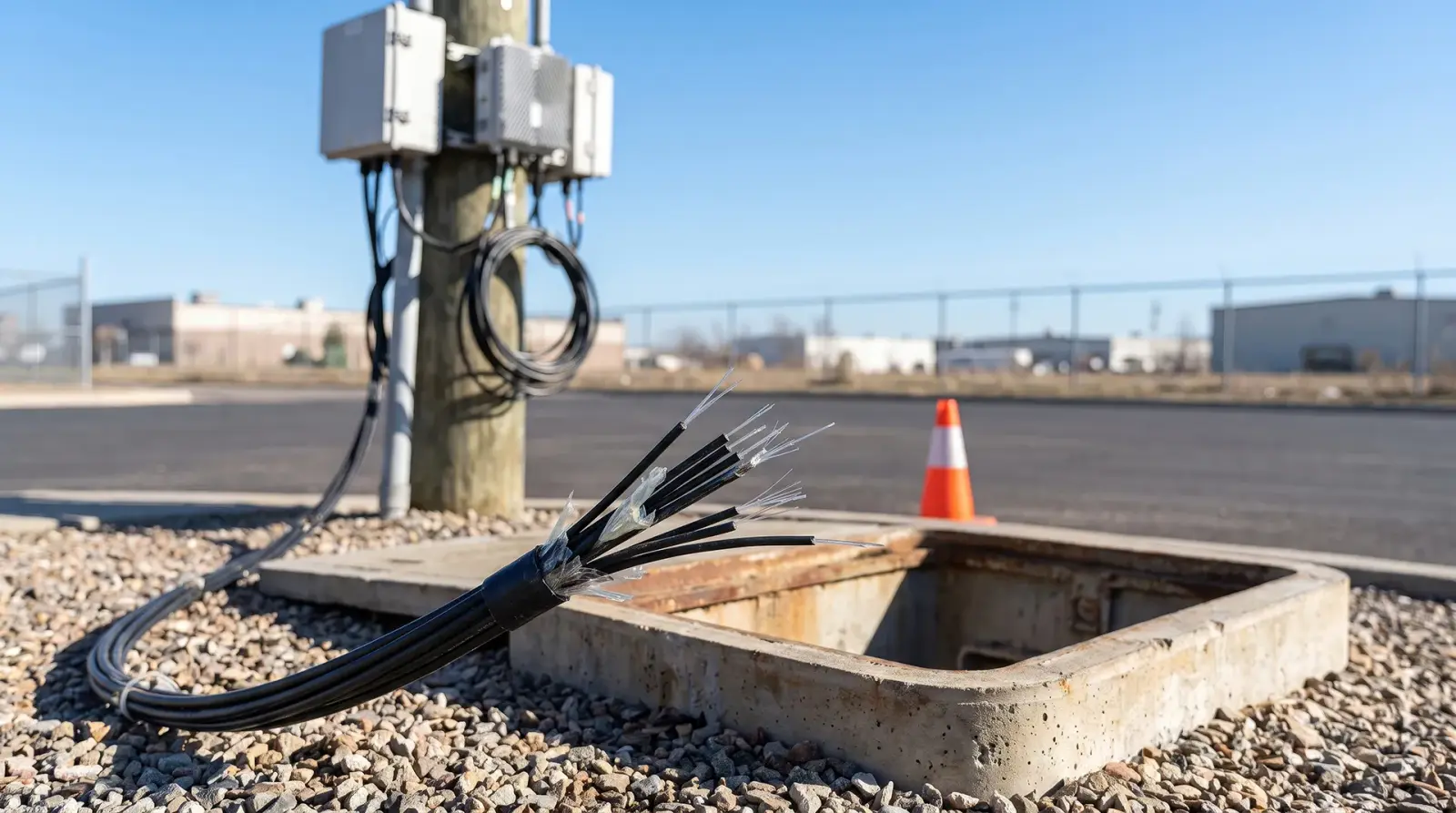
Fiber optic internet sends data as pulses of light through hair-thin strands of glass. Because light doesn’t degrade over distance or interference the way electrical signals do, fiber can carry enormous amounts of data with very low latency and very high reliability. Most modern residential fiber networks use a technology called GPON or XGS-PON, where a single fiber strand from the provider’s equipment is split to serve multiple homes, each getting a dedicated logical connection.
What fiber is genuinely great at:
- Low latency and jitter — critical for online gaming, video calls, and anything real-time.
- Consistent upload speeds — fiber’s upload is typically much closer to its download speed than cable or wireless, which is a nice-to-have for video calls and cloud backups, though most households don’t come close to saturating it either direction.
- Long-term reliability — fiber isn’t affected by rain, dust, wind, or electromagnetic interference the way wireless signals can be.
- Headroom to grow — the physical medium can support speed upgrades for years without digging up the ground again.
The tradeoff: fiber has to be physically constructed to your home — trenched or aerially strung, house by house, street by street. That makes it the gold standard for density and reliability, but it’s slow and expensive to build, especially in areas with difficult terrain, HOA permitting delays, or low housing density. And despite the “dedicated fiber line” language in a lot of marketing, most residential fiber (GPON/XGS-PON) actually splits the capacity of a single fiber strand across a group of homes — commonly 32 or more — sharing it in much the same way a cable or wireless network does.
How Fixed Wireless Internet Actually Works
Fixed wireless delivers internet using radio signals, typically from a tower or elevated point, to a small receiver mounted on your home — no trench, no buried cable. Modern fixed wireless (including the licensed and lightly-licensed spectrum many providers use today) can deliver speeds that rival entry-to-mid-tier fiber plans, often within days of a tower going live rather than months of construction.
What fixed wireless is genuinely great at:
- Fast deployment — a tower can bring service to hundreds of homes in a matter of weeks, versus the months or years fiber construction can take in the same area.
- Reaching areas fiber hasn’t gotten to yet — rural and semi-rural parts of Arizona, and neighborhoods still waiting on a fiber build timeline, can get high-speed service now instead of waiting years.
- Lower construction cost — which usually means lower prices for comparable speeds in areas where fiber isn’t yet economical to build.
The tradeoff: fixed wireless requires line-of-sight or near-line-of-sight to the tower, so terrain, dense tree cover, and building obstructions matter. It can also be more sensitive to severe weather than buried fiber.
Here’s the Part Nobody’s Marketing Department Wants to Say Out Loud: All Broadband Is Shared
This is worth being blunt about, because it gets glossed over constantly: virtually no residential internet connection — fiber, fixed wireless, or cable — is truly a dedicated, private pipe all the way back to the internet. Fiber (GPON/XGS-PON) splits a single strand’s capacity across dozens of homes. Fixed wireless shares a tower sector’s capacity across everyone connected to it. Cable shares a node across a neighborhood. This isn’t a flaw unique to one technology — it’s simply how broadband networks are built to be economically viable, and it’s true industry-wide, regardless of which company’s truck is parked outside your house.
The number that actually determines whether your connection holds up during peak hours isn’t the technology — it’s how conservatively or aggressively the provider has oversold that shared capacity. A well-run network sizes its shared bandwidth with real headroom, monitors utilization, and reinvests before a segment gets congested. A network chasing growth and margin can sell far more capacity than it can actually deliver at peak times, banking on the fact that not everyone maxes out their connection simultaneously — until enough of them do, and everyone’s speeds suffer during the exact hours they need it most (evenings, weekends, when the whole neighborhood is home).
That’s the real question to be asking — not “is this fiber or wireless,” but “how is this network engineered and managed, and is this provider transparent about it?”
Neither technology wins in every scenario — they’re built to solve different problems. The real comparison isn’t “fiber vs. wireless” in the abstract; it’s what’s actually available at your address, today, versus what’s being promised for some future date. A fixed wireless connection that’s live and working right now beats a marketing brochure for “8-GIG” fiber that hasn’t broken ground on your street yet — and may not for another year or two.
Now Let’s Talk About “8-GIG” — What That Number Actually Means
Here’s where the marketing gets slippery.
1. It’s almost always a theoretical port speed, not a guaranteed real-world speed. “8-GIG” typically refers to the maximum throughput of the equipment on both ends of the connection under ideal lab conditions — not what you’ll actually see running a speed test on a Tuesday night. Real-world throughput depends on your router, your device, network congestion, and dozens of other variables.
2. Almost nothing in your house can use it. An 8-Gbps connection requires a wired Ethernet connection and a network card capable of receiving that much data — most laptops, phones, and smart TVs top out at 1 Gbps wired, or considerably less over Wi-Fi. In practice, the overwhelming majority of households pushing an “8-GIG” connection through a standard Wi-Fi router will see real-world speeds in the hundreds of Mbps, not gigabits — because Wi-Fi, not the internet connection, is almost always the bottleneck.
3. You almost certainly don’t need it. Here’s what actual bandwidth usage looks like for common activities:
| Activity | Typical Bandwidth Needed |
|---|---|
| 4K video streaming (per stream) | 15–25 Mbps |
| Video conferencing (Zoom/Teams) | 3–8 Mbps |
| Online gaming | 3–10 Mbps (latency matters more than speed) |
| Large file / cloud backup | Benefits from higher speeds, but bursts, doesn’t sustain |
| Smart home devices | Well under 1 Mbps each |
A household of five, all streaming 4K simultaneously while someone games and someone else is on a video call, is comfortably covered by a few hundred Mbps — nowhere near even a single gig, let alone eight. The “bigger number wins” marketing isn’t dishonest about the equipment’s ceiling — it’s just mostly irrelevant to what actually shows up in your daily life.
4. Check the upload number, but keep it in perspective. Some plans advertise a large download speed with a much smaller upload speed attached. For the average household — streaming, browsing, the occasional video call — that gap rarely matters in daily use. It becomes worth paying attention to only if you regularly upload large files, run a home server, or livestream. For most people, it’s a minor line item to check, not a reason to choose one provider over another.
So What Should You Actually Look For?
Instead of chasing the biggest number on the door hanger, ask your provider these questions:
- How is this network engineered to handle peak-hour demand, and is the provider willing to talk about it?
- Is the upload speed reasonable for how I actually use the internet — video calls, cloud backups, uploading photos or files?
- Is this technology already live at my address, or is it a construction promise with no firm date?
- What happens to my price after the first-year promo rate ends?
Bluespan: The Right Technology for Your Address, Not a One-Size Pitch
Because we operate both fiber and fixed wireless networks across Arizona, we’re not incentivized to oversell you a number you’ll never use. We build fiber where density and demand support it, and we deploy fixed wireless to get reliable, fast internet to homes and businesses faster in areas where a fiber build is still years out. Our job is matching the right technology to your address — not the biggest number on a truck wrap.
If you’re comparing offers right now, don’t get hypnotized by “8-GIG.” Ask what’s actually live at your address today, ask how the network is managed during peak hours, and ask who you’ll be calling when something goes wrong. Those are the answers that actually matter.
Bluespan delivers fiber optic and fixed wireless internet across Arizona, from Flagstaff to the U.S.-Mexico border. Check what’s available at your address to see the right technology for your home.